Best for Local-First Context Memory for AI Coding Agents in 2026
In 2026, one of the most painful bottlenecks in engineering workflows is that stateless coding agents often burn 5,000–20,000 tokens per session just to reconstruct project context they already had moments ago.

Key Takeaways
| What you’re trying to fix | Local-first memory approach | What improves |
|---|---|---|
| Context loss between runs | Persist facts and decisions locally, then retrieve only what’s relevant | Higher consistency, fewer regressions |
| Slow, bloated prompts | Selective retrieval, not full history dumping | Lower latency and cost |
| “Why did the agent do that?” | Store rationale and traceable references to files, commits, and tickets | Debuggability for teams |
| Tooling friction | Integrate memory with your coding agent runtime and editor events | Fewer manual steps |
| Inconsistent knowledge | Versioned memory, with invalidation when code changes | Less stale context |
- Local-first context memory for ai coding agents is about keeping the useful bits close, then retrieving them intentionally.
- We recommend treating memory like a “project layer,” not a generic chat log.
- Use structured memory (events, decisions, references) alongside embeddings for fast lookup.
- If you want agent memory patterns that match real tooling, start with editor and agent docs like Visual Studio Code agent memory guidance.
- For systems thinking, you can browse designs like Palace Memory (a concrete local memory direction).
- To understand local-first concepts as a research thread, look at ProjectMem on arXiv.
Why local-first context memory matters for coding agents in 2026
When agents operate across multiple steps, days, or CI cycles, the biggest failure mode is not “model intelligence,” it’s missing context at the moment it matters. Local-first context memory for ai coding agents fixes this by storing and indexing the project-specific information the agent should reuse next time.
In practice, we see teams hit the same pattern in 2026. An agent starts a change, makes assumptions, edits files, and then the next run forgets why the earlier decisions were made. The workaround is usually long prompts and repeated instructions, which is expensive and still brittle.
Local-first memory changes the unit of reuse. Instead of “replay everything,” you store what’s important, retrieve what’s relevant, and keep the rest out of the prompt.
- Better continuity: The agent remembers decisions, constraints, and definitions.
- Lower overhead: Only relevant snippets and prior reasoning make it into the active context window.
- More team trust: Stored references help reviewers understand where an idea came from.
And yes, we still need retrieval and ranking behavior, but we also need memory that is stable across runs, not dependent on whatever happened to be typed in the last chat.
What “local-first” actually means for agent memory
“Local-first” is not just “store data somewhere.” For local-first context memory for ai coding agents, it means the memory layer is designed to be usable as part of the development loop, with predictable behavior even as workloads scale.
We like to break it into three practical properties.
1) Persistence that matches the project
Agent memory should attach to a repository workspace, not a temporary conversation. That includes file-level facts, decisions, and links between actions and outcomes.
2) Retrieval that selects, not floods
If your system dumps full chat history into every coding agent call, you lose the very benefit of memory. Selective retrieval keeps latency and token usage under control.
3) Invalidation when the codebase changes
In 2026, code moves fast. If a stored memory is about an API signature or a component contract that changed, the memory should degrade gracefully or be invalidated.
codevex.app, opt-in thinking: If your system asks users to opt in, you should treat memory as a feature with clear boundaries (what we store, why we store it, and how users can turn it off) rather than a hidden side effect. That same principle applies even if you build your own memory layer.
If you want to see how teams think about agent memory boundaries and controls, review pages like codevex.app privacy and codevex.app opt-in as examples of user-facing framing.

Memory architecture that works: graph events, references, and retrieval
In our experience, the most reliable local-first context memory for ai coding agents uses more than one representation. You usually need structured memory for “what happened” and vector-like lookup for “where similar things live.”
Here’s a concrete architecture we recommend for coding agents.
Event log (what the agent did)
Store “agent events” like: created a file, updated a function, added a migration, ran tests, or rejected a solution. Keep timestamps and outcome metadata.
Decision records (what the agent believed)
Store the reasoning in a compact form. For example, “Chose implementation A because interface X is stable and aligns with existing patterns,” plus references to the files that justify it.
Reference anchors (what to look at next time)
Memory should point back to tangible sources. Include file paths, symbols, commit hashes, or issue links. This turns memory into something a human can verify.
Retrieval layer (what to include in the next context)
When the agent needs context, retrieve the smallest set of relevant memory items. For example, if the task is “extend an API endpoint,” retrieve prior events and decision records specifically related to that endpoint family.
If you want a practical starting point for memory patterns in an editor workflow, check Visual Studio Code agent memory. It helps translate the abstract idea of “memory” into the mechanics of agent runs.
And if you want to see local-first memory thinking in a research framing, skim ProjectMem on arXiv to ground the event-capture mindset.
Best picks for local-first context memory: practical directions and tools
We can’t pretend there’s one universal implementation. But we can point you toward directions that are aligned with local-first context memory for ai coding agents, including concrete projects and agent-oriented memory systems.
ProjectMem-style local project memory
ProjectMem is a good reference point if you want to understand memory as a captured “project layer,” not just a transcript. It emphasizes the value of logged events and structured extraction that can be reused across sessions.
Start here: ProjectMem on arXiv.
VS Code agent memory guidance for real workflows
For teams building inside existing developer tooling, Visual Studio Code agent memory is useful because it assumes agents need to coordinate with editor context, not just read text dumps.
Local memory concepts from Palace Memory
If your goal is to make memory feel like a workspace asset, Palace Memory is a notable local-first concept direction. It maps neatly to the idea of persistent, retrieval-backed knowledge for repeated tasks.
Kontexta for agent context design
Kontexta is worth looking at if you’re thinking about how context is managed and reused in practical systems. For local-first memory, the core question is always the same, what gets stored, how it is retrieved, and what happens when it goes stale.
Zep-style fast context retrieval patterns
Local-first context memory for ai coding agents is only as good as the retrieval latency. Designs like PMB AI and related context engines inspire patterns where graph-based or indexed retrieval stays fast at scale.
In many setups, speed comes from narrowing the candidate set early, then using richer scoring for the final selection.

Latency and cost: why selective retrieval beats full history
One reason local-first context memory became a real engineering discipline in 2026 is that selective retrieval is measurable. Instead of paying latency and token costs for full-history context, systems retrieve only what the agent needs for the current task.
In benchmarks comparing approaches, local memory retrieval can be dramatically faster than “full-context” prompting. For example, selective memory retrieval can hit 1.44s vs 17.12s in p95 latency comparisons, which is the difference between an agent that feels interactive and one that feels sluggish.
So the design goal is simple. Keep a stable local store, retrieve a small subset, and avoid re-sending irrelevant conversation content.
How we design retrieval for coding tasks
- Classify the task: “Bug fix,” “refactor,” “add feature,” “write tests,” or “update docs.”
- Identify target files or modules: Pull from the workspace structure and agent actions.
- Retrieve memory by anchors: Look up prior events tied to those files, symbols, or decisions.
- Compress the memory: Summarize or extract only the fields required for the next reasoning step.
When we implement this, we aim for consistent context selection, not random recall. Random recall leads to “almost right” actions that waste runs.
If you’re building around an agent that already has a memory concept, make sure your local-first context memory for ai coding agents plugs into that architecture rather than running in parallel. Parallel memory often duplicates work and increases inconsistency.
Operations in 2026: governance, opt-in, and safe logging
Local-first memory creates new operational responsibilities. In 2026, teams increasingly want agent logs to be transparent, controllable, and reviewable. That includes what we store, how long we store it, and how memory changes over time.
We recommend building four governance features into the system from day one.
- Clear opt-in controls: Make it obvious when memory is active and what it captures. Use something like opt-in as a template for user-facing framing.
- Delete and export: Provide deletion paths and export memory so teams can audit what’s stored.
- Scope boundaries: Separate “team knowledge” from “agent session notes,” and avoid mixing them blindly.
- Traceability: Each memory item should have references that allow humans to confirm its origin.
For user-facing policy language examples (again, as a framing reference), you can review codevex.app privacy and codevex.app terms. Even if you build something different, the principle stays the same, memory is a user feature.
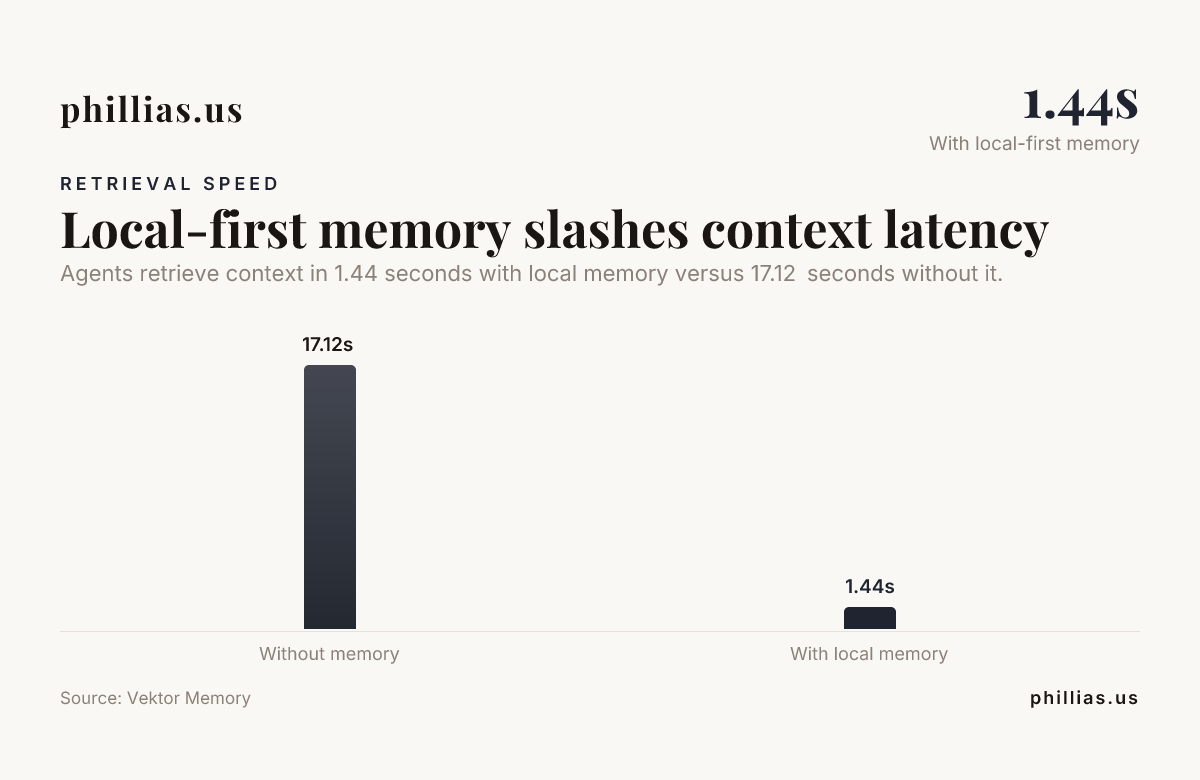
Agents retrieve context in 1.44 seconds with local memory versus 17.12 seconds without it.
That latency difference matters because coding agents need feedback loops. When the agent gets context quickly, it can iterate on edits, run tests, and adjust before you hit the next waiting point.
What to implement first (and what to skip) for local-first context memory for ai coding agents
If you want a working local-first context memory for ai coding agents system in 2026, we suggest starting with the smallest slice that delivers continuity and retrieval accuracy.
Here’s a staged plan we would use.
Stage 1: Capture a minimal event log
- Store “agent ran,” “agent edited,” “agent tested,” and “agent decided” events.
- Attach references to the affected files or modules.
- Keep it simple, do not build a complex ontology on day one.
Stage 2: Add decision summaries and anchors
- Extract compact “why” explanations for non-trivial changes.
- Link each explanation to the code it depends on.
- Use the anchors as retrieval keys.
Stage 3: Make retrieval selective and fast
- Retrieve only memory items relevant to the current target files.
- Cap the number of memory entries placed into the prompt.
- Prefer “few good items” over “many mediocre items.”
Stage 4: Add invalidation rules
- Invalidate memory when file hashes or symbol signatures change.
- When invalidated, fall back to broader retrieval or ask the agent to re-derive assumptions.
What we would skip early is any approach that tries to mirror the entire repo’s state every time. You will end up duplicating work and reintroducing the context flooding problem.
Also, avoid building memory that only works when the agent gets the exact same prompt phrasing. Local-first memory should work even when the user asks the task differently.

Frequently Asked Questions
What is local-first context memory for ai coding agents?
Local-first context memory for ai coding agents is a memory layer that persists project-specific knowledge locally and retrieves only the relevant items for each new coding run. In 2026, teams use it to reduce context loss, cut unnecessary token usage, and keep agent behavior consistent across sessions.
How do I stop an AI coding agent from forgetting my project decisions?
Store decisions as structured memory (events and rationale) with references to the exact files or symbols they depend on. Then use selective retrieval so the agent loads those decision records into the working context only when the task overlaps.
Is vector search enough for local-first context memory for ai coding agents?
Vector search helps, but it is rarely sufficient by itself for coding workflows. For local-first context memory for ai coding agents, you typically need reference anchors and an event or decision record layer so retrieval stays precise when code changes.
Will local-first memory reduce prompt size and latency in 2026?
Yes, when retrieval is selective. Measurements in 2026-style evaluations show large p95 latency improvements when agents retrieve focused context locally instead of sending full-history context.
What should be stored in local-first memory for software development?
Store agent events, decision rationale, and traceable references like file paths and module or symbol anchors. Keep memory scoped to the workspace so local-first context memory for ai coding agents remains project-specific and reusable.
How do we handle privacy and opt-in for agent memory?
Provide clear opt-in controls, retention and deletion options, and a way to inspect what was stored. If you want a reference for user-facing framing, review codevex.app opt-in and privacy style concepts, then apply them to your own system.
Conclusion
Local-first context memory for ai coding agents is how we make agents dependable in real engineering workflows. In 2026, the best results come from persistent project-scoped memory, selective retrieval, and reference-backed decision records that stay valid as code evolves.
If you build toward that, your agent stops “re-figuring everything” every run, and it starts carrying forward the parts of context that actually matter.